RADORA provides professional radon mitigation in Ottawa and surrounding communities. Our C-NRPP-certified service helps homeowners reduce elevated radon levels with solutions tailored to their homes.
Radon mitigation reduces indoor radon levels by limiting the movement of radon-containing soil gas into the home. One common method uses a fan and PVC piping to draw soil gas from beneath the foundation and discharge it safely outdoors.
Every home is different. RADORA reviews the foundation, construction details, and available pipe routes to recommend a suitable mitigation approach.
Every home is different, but most radon mitigation projects follow a clear process—from reviewing the test result to designing the system and explaining the final setup.
Review the radon test result, foundation type, access points, and possible pipe routes. This helps determine the most suitable system approach.
Plan the suction point, fan location, and discharge route for the building. Confirm the proposed scope before installation begins.
Commission the system, explain the monitoring indicators, and discuss any follow-up testing or next steps.
An effective radon mitigation system starts with understanding how soil gas moves beneath and into a home. Foundation construction, sub-slab conditions, sump pits, crawlspaces, and existing ventilation can all influence the design.
RADORA evaluates these conditions to recommend a suitable approach, using CAN/CGSB-149.12-2024, Canada’s standard for radon mitigation in existing buildings, as a technical reference.
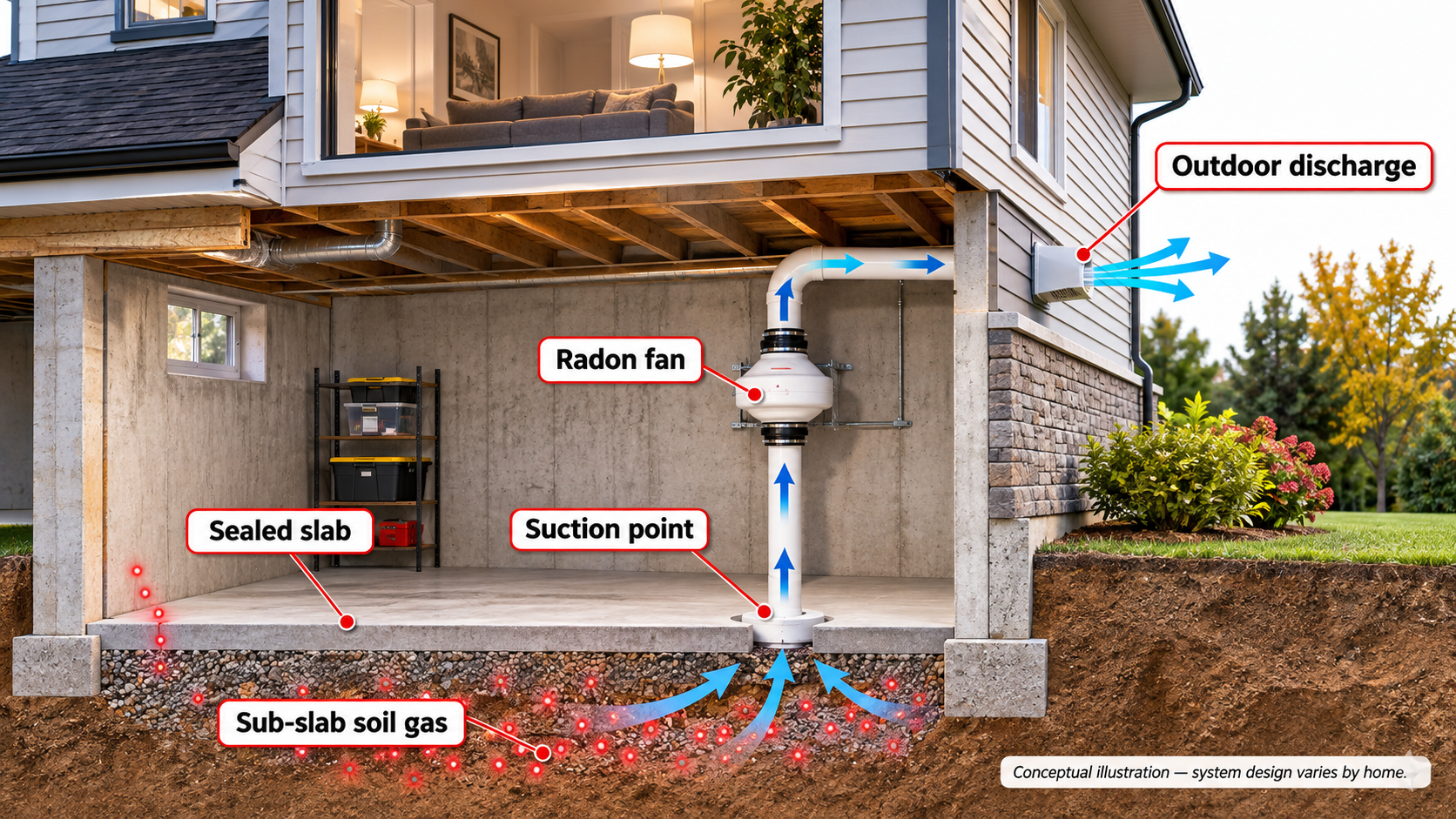
Conceptual illustration. Actual system design, fan location, and discharge placement depend on the property and applicable Canadian standards.
Active sub-slab depressurization is a common and effective radon mitigation method. A fan creates suction beneath the concrete slab, collecting soil gas and directing it safely outdoors before it enters the living space.
Diagnostic testing, including pressure field extension testing where appropriate, helps determine suction point locations and system requirements.
Unsealed sump pits, floor drains, and foundation penetrations can provide pathways for radon-containing soil gas.
Depending on the building, appropriate sealing, airtight sump covers, or drain treatments may form part of a complete mitigation solution. Sealing alone is generally not a substitute for an effective depressurization system.
Homes with exposed-soil crawlspaces or multiple foundation types may need a different approach.
Depending on the property, solutions can include a sealed crawlspace membrane with sub-membrane depressurization or a combination of methods designed for the connected foundation areas.
After installation, the system should be checked for proper operation. Homeowners should understand how to monitor the system and when follow-up testing is required.
Short-term verification and subsequent long-term radon measurements help confirm that the system is effectively reducing indoor radon levels.
Base mitigation decisions on a long-term radon test.
Take corrective action within one year—sooner at higher levels.
Reduce radon as low as reasonably achievable.
Health Canada’s guideline for indoor radon is 200 Bq/m³. If your home’s long-term average exceeds this level, corrective action is recommended within one year, and sooner at higher concentrations.
Even below 200 Bq/m³, reducing radon further can provide additional health benefits.
Already have a radon test result? Share your reading with RADORA, and we’ll help you understand the options for your property.
For more information about radon mitigation methods, system performance and post-installation testing, see Health Canada’s guide to reducing radon in your home
RADORA provides residential radon mitigation services throughout Ottawa, including Kanata, Stittsville, Barrhaven, Nepean, Orléans, Manotick and nearby communities.
Every home is different. Concrete basement slabs, sump pits, crawlspaces and combined foundations can affect how radon enters a building and how a mitigation system should be designed.
Our C-NRPP-certified approach includes reviewing your radon results, assessing the foundation, considering suitable diagnostic testing and planning an appropriate radon reduction system.
We provide clear recommendations and written estimates so homeowners understand the proposed work before installation begins.
Explore our service area or request a radon mitigation assessmentto discuss your property.
The cost depends on your home’s foundation type, sub-slab conditions, access, pipe routing, and the complexity of the installation. RADORA offers an initial mitigation assessment and provides a written estimate outlining the proposed work and costs before installation.
Many residential radon mitigation systems can be installed in one day. More complex foundations, crawlspaces, or combined mitigation systems may require additional time. We’ll explain the expected installation schedule during your assessment.
The goal is to reduce indoor radon to the lowest reasonably achievable level. Active soil depressurization systems can significantly reduce radon concentrations, often by more than 80–90%. Actual performance varies depending on the home and must be verified through testing.
After installation, the system is checked for proper operation. Short-term radon testing helps verify the initial reduction. A long-term test during the first heating season after installation provides a more reliable assessment of performance. Periodic system inspections and radon retesting every five years are also recommended.
A long-term radon test lasting at least 91 days is the recommended way to establish your home’s radon concentration. If your long-term result exceeds Health Canada’s guideline of 200 Bq/m³, corrective action is recommended. If you already have a test result, RADORA can review it and discuss the next steps.
Have a radon result? Share the reading, test dates, device type and measurement location so we can discuss the next step.
Tell us about your property. We’ll help you understand the options.